Make Your Own World?
On LittleBigPlanet and whether AI can give everyone the means to make a game.
At E3 2008, Media Molecule showed the world LittleBigPlanet. I remember watching a recording of the demo on YouTube. There were Sackboys and Sackgirls on a skateboard, a handmade world stitched together from fabric and cardboard, and joyful music. The tagline was Play, Create, Share, and the game delivered on that on release and for some time after.
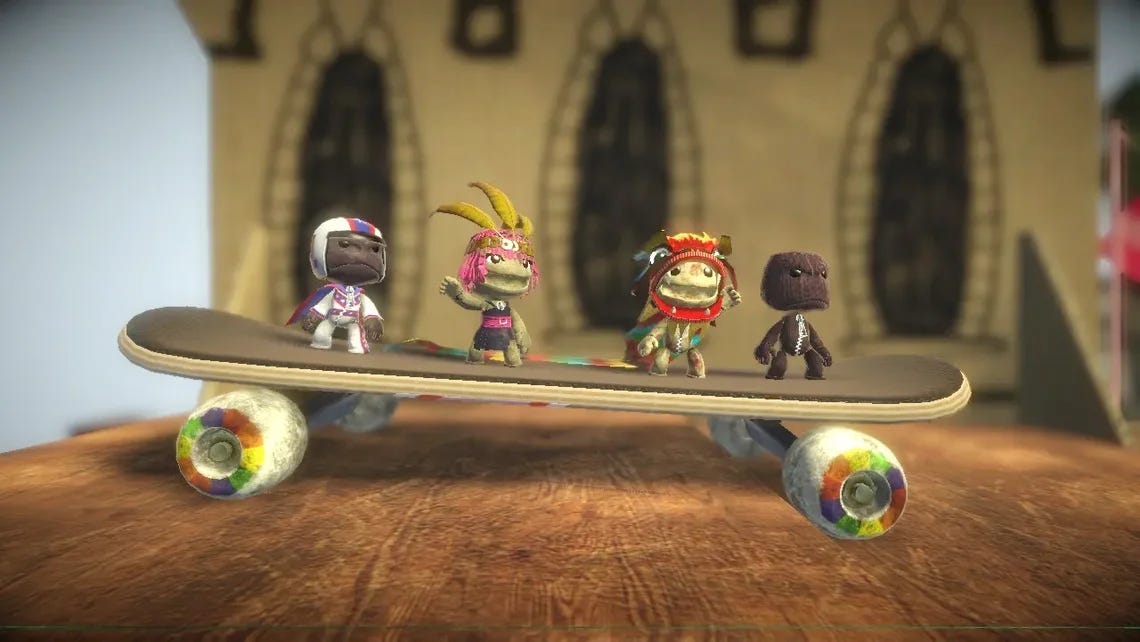
Lately there've been a lot of demonstrations on X in which people are using generative AI to create their own games. In theory and in practice, anyone has the ability generate a game by prompt. Why settle for the 2.5 dimensions offered by LittleBigPlanet when you can create your own world? Is the future of gaming?
I don't think most people want to make games. And I think the history of gaming proves it. Consider the cognitive load spectrum that games already occupy.
From passive to generative:
- TikTok: near-zero load, pure reception
- Watching a film: emotional engagement, no agency
- Watching someone else play: you understand the rules, feel the stakes, but stay outside
- Playing FIFA or Call of Duty: low narrative load, high motor and competitive load
- Playing a story-driven RPG: high load across multiple dimensions simultaneously
- Building in Minecraft or Roblox: creation mode, a different brain entirely
FIFA players and Final Fantasy players are having fundamentally different experiences that happen to share a controller. The person grinding ranked matches in Call of Duty is not looking for a narrative. They are looking for the specific feeling of zoning out and of dopamine hits. It will probably not move the needle much for the person who just wants to run a counter-strategy with their friends on a Saturday night.
There is a useful analog in physical sports. A ball and an open field contain infinite possible games. The rules could be anything. But we keep playing soccer. We keep playing basketball. The constraint is not a failure of imagination — it is the culture. The shared history, the inherited rules, the fact that everyone already knows the game. Games, like sports, are social contracts first and creative canvases second.
The creator economy has already shown us what happens when you remove the skill ceiling from creative work. The rough ratio holds across platforms: about one percent of users create, nine percent engage and remix, ninety percent consume. YouTube, TikTok, Substack — the audience dwarfs the authors in every case. Roblox and Minecraft follow the same pattern. Most players never build anything. They play what the one percent made. The platforms are defined by their creators, but sustained by their consumers.
AI will almost certainly expand who can enter that one percent. The passionate teenager who has a game in their head but no programming skills gets new tools. The hobbyist level designer who kept hitting a technical ceiling finds it removed. That is genuinely meaningful; it adjusts the ratio, potentially making that 1% into 2%, yet the majority of players remain consumers.
The more instructive comparison is Dreams, Media Molecule's spiritual successor to LittleBigPlanet. Dreams gave players the most powerful creation tools ever shipped in a consumer game. You could build almost anything — full games, short films, music, sculptures. The critical response was reverent. And then, quietly, it died. Sony shut down its servers earlier this year. The reason was that there was almost no one waiting to play what you made. LittleBigPlanet had survived because it understood that Play came before Create, and Create only meant something because of Share. Dreams had the creation without the community, and creation without community is just a very elaborate personal project.
Roblox solved the problem from the other direction. It is a platform first — millions of people already present — and a creation tool second. Your game lives inside a place with a built-in audience. That is not a game design insight. It is a distribution insight. And it explains why a generation of kids is already living Media Molecule's vision inside Roblox and Minecraft and Fortnite Creative, even if those platforms have less of the soul that made LittleBigPlanet feel like something rare.
LittleBigPlanet had a specific aesthetic sensibility — handmade, warm, slightly melancholy under the joy — that came from the people who made it. It felt authored in a way that mattered. The world had a point of view. That point of view is what made playing someone else's level feel like reading a letter from a stranger.