The Prettier Station
Drawing on Rory Sutherland's psycho-logic, the Linear founders' obsession with speed, and a reflection on a trip to London.
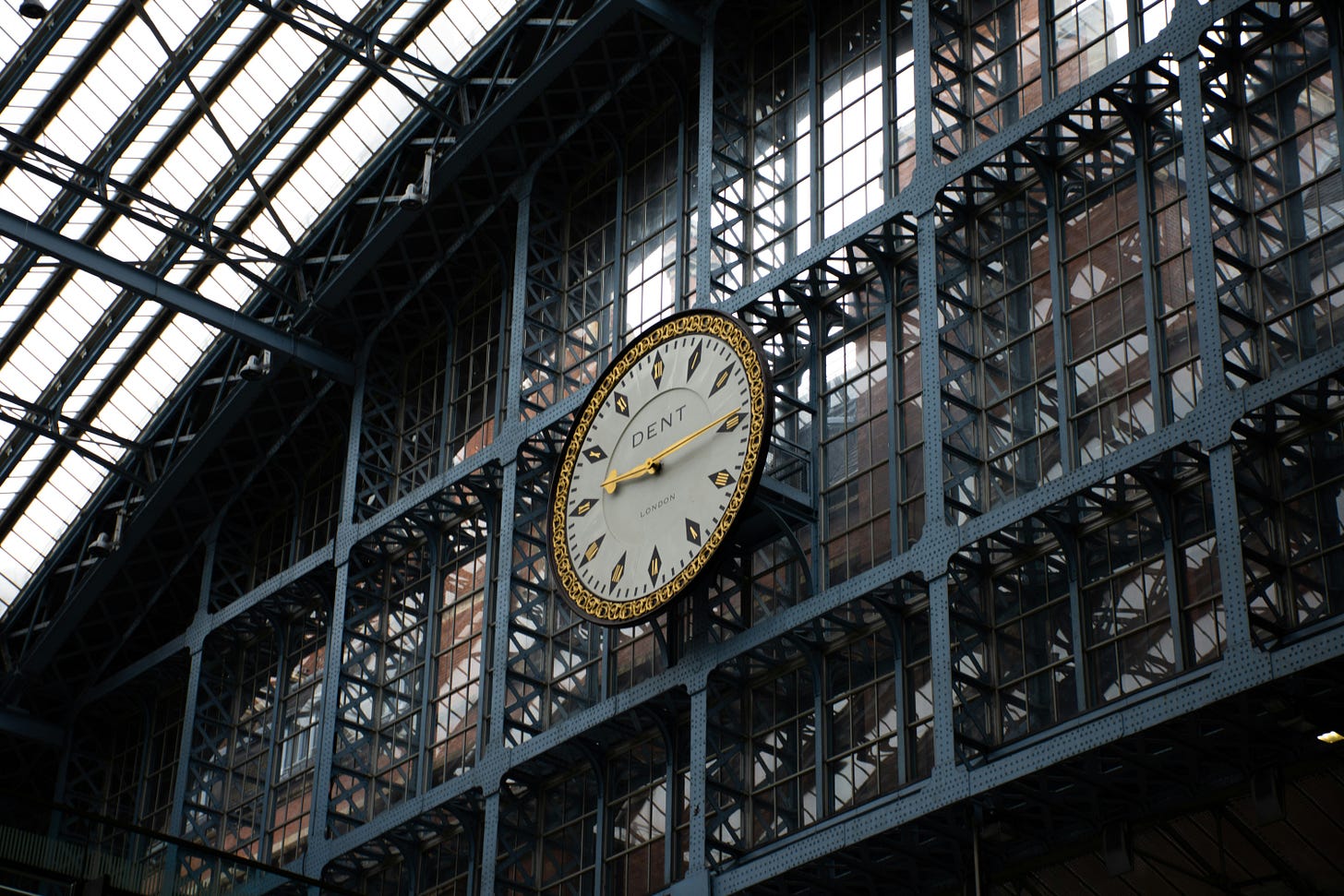
At the top of the escalator from King's Cross, a short corridor leads to St. Pancras International. I turn a corner and the ceiling lifts away. Light falls in long geometric patterns across the floor. Glass panels intersect with a sloped metal ceiling. It is, by any measure, a train station. People are dragging luggage, checking departure boards, buying coffee. But the space creates a visceral reaction in me that has nothing to do with trains.
Rory Sutherland has this observation that if you ask commuters how to improve their journey, they'll say make the train faster. But you could also make the station beautiful, or the ride more comfortable, and the felt improvement might be greater than shaving off ten minutes. He calls this psycho-logic, the gap between what people say they want and what actually changes how they feel. The commuter who says they want a faster train might walk into a beautiful station and forget they were in a hurry.
In the digital realm, there is a bias for speed. "Chase the millisecond" is what the Linear founders say. When something digital makes us wait, even for a second or two, we feel agitated. And over the years, our patience has dwindled even further. We expect that movement through the digital space should be frictionless; something we pass through on the way to what we actually want.
But beauty in physical space operates on different terms. A train station occupies ground that something else could have occupied. Someone decided that the everyday experience of transit mattered enough for there to be a grand building of stone and glass. The physical space has weight. It's scarce and is difficult to change after the fact.
Digital beauty doesn't carry that same cost. A beautifully designed web app is pleasing to look at...but it's ephemeral scaffolding. We zoom past pixels. The opportunity cost of a nice animation is basically zero.
Physical beauty asks something different of us. It takes up space in the world, and so it takes up space in our attention.
I'm thinking about this within the conversation of the taste zeitgeist. Yes, perhaps taste is a differentiator in the world of digital abundance, but the conversation is so focused in that realm. What matters more is how taste manifests within our physical world, within our built environment, to those places where taste is actually a public good. Taste, when it's set within stone and iron and glass, becomes something you can't scroll past.